
Table of Contents
- How Long Do Fresh Roasted Beans Last? The Short Answer
- How Long Do Coffee Beans Last After Roasting? A Timeline by Storage State
- Can Coffee Beans Go Bad? Signs Your Beans Are Past Their Prime
- The Best Way to Store Coffee Beans for Long-Lasting Flavor
- Should You Freeze Coffee Beans? The Portioning Protocol
- Degassing, Roast Level, and Brew Timing: What Changes the Clock
- Conclusion: Drink Bold, Store Smart
- Frequently Asked Questions
Last Updated: October 14, 2026
How Long Do Fresh Roasted Beans Last? The Short Answer
Fresh roasted beans hit peak flavor 4 to 14 days after the roast date, then quality drops fast.
That window is shorter than most people think. At Bootleggin Johnny, we roast in small batches and ship fast for exactly this reason.
So how long do fresh roasted beans actually last? It depends on three things: storage, whole vs. ground, and brew method.
Peak Flavor vs. Drinkability: Two Different Timelines
Peak flavor and drinkability are not the same thing, and most guides skip that distinction.
Peak flavor is the short window when a bean tastes its best: bright aromas, volatile oils, balanced sweetness and acidity.
Drinkability is the longer window when the coffee still tastes good, just less alive. It will not offend you.
Here is how that plays out:
| Stage | Time After Roast | What You Taste |
|---|---|---|
| Resting | 1-3 days | Gassy, flat, muted |
| Peak flavor | 4-14 days | Full aroma, balanced, lively |
| Good but fading | 2-4 weeks | Softer aroma, duller finish |
| Stale | 4-8 weeks | Flat, papery, cardboard notes |
Exact numbers shift with roast level and storage, but the shape of the curve holds.
How Long Do Coffee Beans Last After Roasting? A Timeline by Storage State
How long do coffee beans last after roasting? It depends almost entirely on storage. The bean does not expire on a fixed clock; air, heat, light, and moisture do the damage.
Most guides give one vague range. Better to separate peak flavor from drinkability for each storage state.
| Storage State | Peak Flavor Window | Drinkable Window | What Changes |
|---|---|---|---|
| Freshly roasted, unopened bag | 4-14 days after roast | 3-6 weeks | One-way valve limits oxygen; degassing continues |
| Opened bag, whole beans | 2-7 days after opening | 2-3 weeks | Oxygen enters each time you open it |
| Ground coffee, opened | 1-3 days after grinding | 5-10 days | Surface area multiplies oxidation |
| Frozen whole beans (sealed, portioned) | 1-3 months | 6-12 months | Cold slows oxidation; moisture is the risk |
These numbers shift with roast level, packaging, and how often you open the bag, but the shape holds: whole beans outlast ground, sealed outlasts open, and frozen outlasts room temperature when done right.
Unopened Bag, Opened Bag, and Ground Coffee
Each state has its own clock.
- Unopened bag: 3 to 6 weeks from the roast date if stored cool and dark. The one-way valve lets gas escape without letting air in. Peak flavor usually lands in the first two weeks.
- Opened bag: 2 to 3 weeks at best. Every time you open it, fresh oxygen floods in. If you open it daily, expect peak flavor to last only a few days.
- Ground coffee: days, not weeks. Grinding exposes far more surface area to air. A common pattern is that ground coffee loses most of its aroma within 3 to 5 days.
Why the Timeline Varies So Much
You will see wildly different freshness windows online, from 2 weeks to 2 months.
Roast level matters too. Dark roasts degas faster and fade sooner; light roasts hold up longer because they are denser with less surface oil.
Brew method changes what you notice.
The practical takeaway: pick the window matching your storage state and roast level, then adjust by taste.
Can Coffee Beans Go Bad? Signs Your Beans Are Past Their Prime
Can coffee beans go bad? Yes, but not in the way you might expect. Old beans will not usually make you sick. They just stop tasting like coffee.
The oils that carry flavor go stale through oxidation, starting the moment the bean leaves the roaster. Your job is to slow it down.
Watch for these signs:
- No smell when you open the bag. Fresh beans hit you with aroma. Dead beans smell like nothing.
- Flat, papery taste. The bright notes vanish first. What is left tastes like cardboard.
- Oily, dull surface on dark roasts. Some oil is normal. A greasy sheen plus no aroma means it is done.
The Best Way to Store Coffee Beans for Long-Lasting Flavor
The best way to store coffee beans is in an airtight container in a cool, dark place, away from heat and moisture. That habit does more for flavor than any gadget.
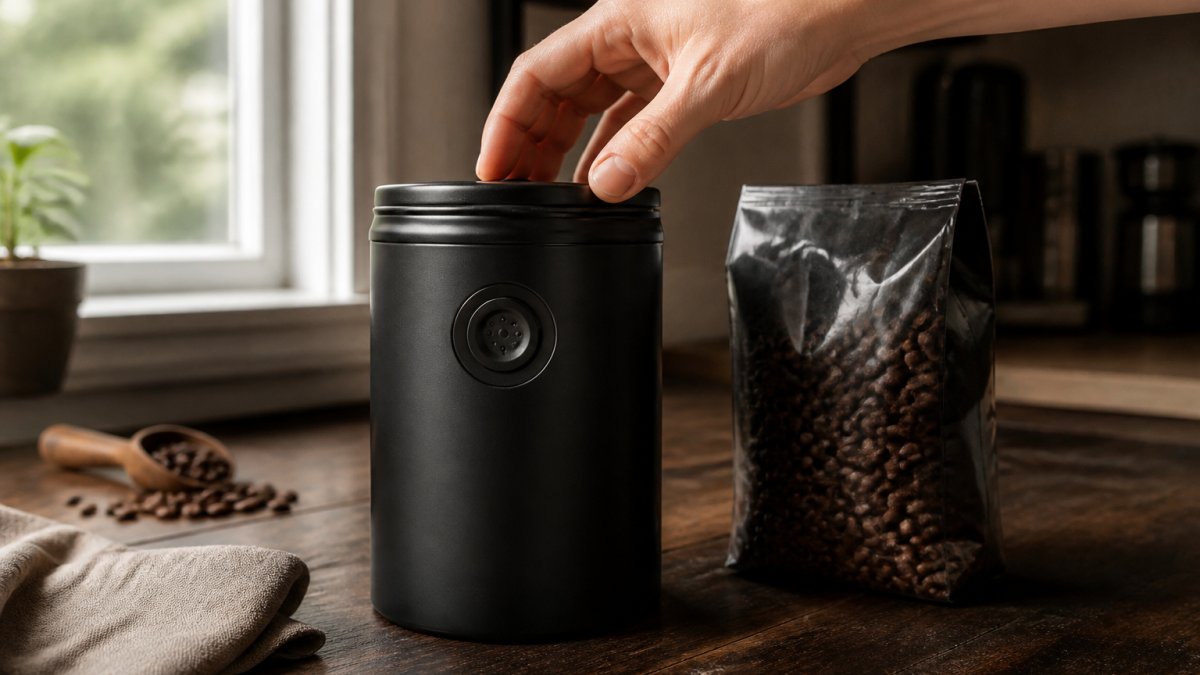
Four enemies attack your beans:
- Air: oxygen drives oxidation, the main cause of stale flavor
- Heat: warmth speeds up every chemical reaction, including the bad ones
- Light: direct sunlight breaks down flavor compounds
Keep the bag sealed, out of the sun, and away from the stove. That is most of the battle.
Containers, Packaging, and the One-Way Valve
A one-way valve is a small vent that lets carbon dioxide out but keeps oxygen from getting in, why good roasters ship in resealable bags with a valve.
What works best:
- The original packaging with its valve, if it reseals well
- A ceramic or stainless steel canister with an airtight seal
- Opacity, so light cannot reach the beans
What works poorly:
- A clear glass jar on a sunny shelf
- A loose bag rolled shut with a clip
- The fridge, which adds moisture and odor
Should You Freeze Coffee Beans? The Portioning Protocol
Should you freeze coffee beans? Yes, if done right. Freezing slows oxidation and can keep whole beans near peak flavor for months instead of weeks.
The catch is moisture and repeated thawing. Get those wrong and you wreck the beans.
Follow this protocol:
- Buy whole beans only. Ground coffee has too much surface area for freezing to help.
- Portion into single-use amounts. One bag per week of brewing, sealed tight.
- Use an airtight, freezer-safe bag or vacuum seal. Squeeze out all the air.
- Label with the roast date. You will forget. Write it down.
- Freeze fast and thaw fully. Pull one portion, let it sit sealed at room temp, then grind.
- Never refreeze. Each thaw cycle pulls in moisture.
Roasted beans are porous. They absorb whatever is around them. So keep them away from strong-smelling food.
Degassing, Roast Level, and Brew Timing: What Changes the Clock
Degassing is the release of carbon dioxide from beans after roasting. It is why fresh beans taste flat for the first few days and why the roast date matters. It also changes how you should brew, varying by roast level and brew method.
Most guides mention degassing and move on. The practical question: when are beans ready to brew, and how does that change with roast level and brew method?
Why Beans Need to Rest After Roasting
Right after roasting, beans are full of carbon dioxide.
Resting lets the gas escape slowly. As CO2 leaves, the bean becomes more permeable to water and extraction evens out, why almost every roaster recommends waiting at least a day or two before brewing.
Beans often taste best after 3 to 7 days of rest, but the ideal rest depends on roast and brew method.
How Rest Time Varies by Roast Level
- Dark roasts: Degas faster because they are more porous from longer roasting. They often peak 2 to 5 days after roast and fade sooner. If you wait too long, you miss the bold, syrupy window.
- Medium roasts: A middle ground. Peak flavor often lands 4 to 10 days after roast. This is the most forgiving range for most brew methods.
- Light roasts: Denser and less porous, so they degas more slowly. They may need 7 to 14 days to hit peak flavor. Some light roasts taste best at two weeks or more.
These are general patterns, not rules. A light roast from a high-altitude farm may behave differently than one from lower elevation. Taste is the final judge.
How Rest Time Varies by Brew Method
- Espresso: Rewards a shorter rest, often 3 to 7 days. Too fresh, and the shot gushes and tastes sour. Too old, and it loses crema and sweetness. Espresso is the most sensitive to freshness.
- Pour over and drip: Do well with a few days more rest, often 5 to 12 days. The longer contact time and paper filter smooth out some of the gassiness.
- French press and immersion: More forgiving. You can brew a bit fresher or a bit older and still get a good cup.
Match your brew to the bean. A light roast shines in a pour over a week or two off the roast. A dark roast peaks early and drinks bold right away.
How to Tell When Beans Are Ready
You do not need a lab. Your senses will tell you.
- Smell: Freshly roasted beans smell strong and sweet. As they rest, the aroma mellows. When it smells flat or papery, they are past peak.
- Bloom: When you pour hot water over grounds, fresh beans puff up and bubble. That is CO2 escaping. A weak bloom means the beans have degassed most of their gas.
- Taste: If the cup tastes gassy, sour, or flat, adjust your rest time. Try a day or two longer, or brew a different batch.
A quick note on bourbon-inspired roasts: ours carry the flavor notes, not the alcohol. Store them like any other bean, cool, dark, airtight, and give them the same rest time based on roast level.
Conclusion: Drink Bold, Store Smart
The clock starts at the roaster, not the shelf. Fresh roasted beans give you a short peak-flavor window and a longer drinkable one. Store them right and you stretch both.
At Bootleggin Johnny, we roast in small batches and ship fast, so your bag arrives close to peak. Our single-origin beans and bold blends, from the Big Boss Blend to The Sampler, are built for people who care how their coffee tastes.

Frequently Asked Questions
Can coffee beans go bad?
Yes, but not in a food-safety sense. Coffee beans go stale rather than spoil. Once roasted, beans begin losing volatile oils and aroma compounds through oxidation. Whole beans stay at their best for two to four weeks after the roast date, ground coffee for days, and unopened vacuum-sealed or valve-sealed bags for up to six months. After that, the beans are safe to brew but taste flat, papery, or rancid depending on how they were stored.
How long do whole coffee beans stay fresh after roasting?
Whole beans hit peak flavor roughly three to fourteen days after roasting, depending on roast level. They remain good for about three to four weeks in an airtight container kept in a cool, dark place. Light roasts tend to hold their brightness slightly longer than dark roasts, which release oils faster. After the four-week mark, flavor drops off quickly even if the beans still look fine.
Should you freeze coffee beans?
Freezing works well if you portion correctly. Divide beans into single-use portions in airtight bags, squeeze out air, and freeze. Grind from frozen and brew immediately. Avoid repeatedly thawing and refreezing, and never freeze and thaw a large bag you dip into daily, because moisture and temperature swings speed up staling. For a two-week supply you drink daily, a cool dark cabinet beats the freezer.
How can you tell if roasted coffee beans are stale?
Stale beans lose aroma first. Open the bag and smell: fresh beans hit you with fruit, chocolate, or floral notes, while stale beans smell flat or like cardboard. Visually, dark roasts that once looked oily turn matte and dry. In the cup, stale coffee tastes weak, bitter, or papery even when you use the same ratio. If your brew suddenly needs more grounds to taste like anything, the beans are past their window.
Great coffee rewards good habits. The problem is that most bags sit too long before they reach your kitchen. Bootleggin Johnny roasts in small batches and ships to your door, so your beans land near peak flavor, not weeks past it. Choose whole bean, store it airtight, and grind right before you brew. Shop bold blends and taste the difference freshness makes.